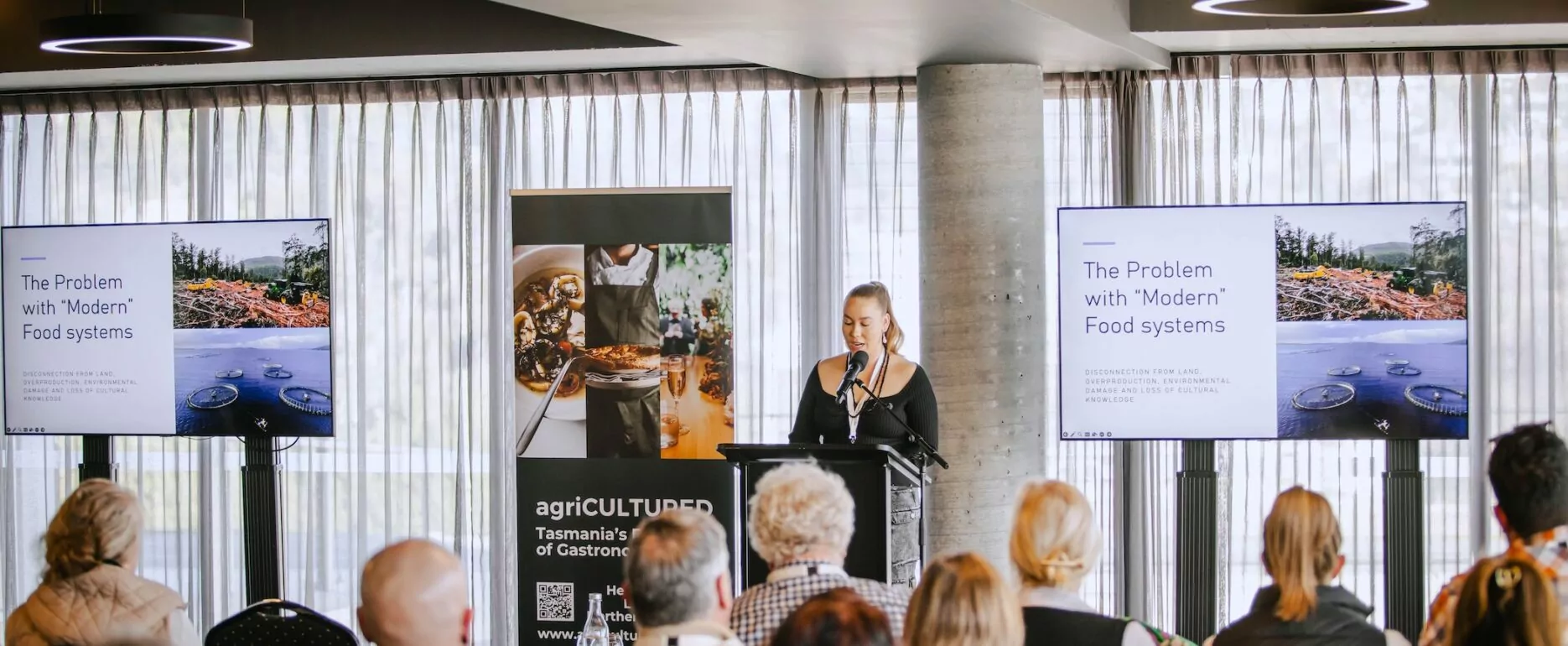
This year’s theme – Food is Political explores how power, policy, climate, and community shape what we eat. Through keynotes and panels spanning agroecology, food justice, and innovation under climate and policy pressure, the program examines the forces driving Australia’s food future and the cultural, ecological and social relationships that underpin it. All while keeping the conversation grounded in optimism and possibility.
Full sit down lunch by Hubert and Dan will be served in the East Wing at Albert Hall creating space for networking and meaningful conversations with leaders and peers across the food, policy and sustainability sectors.
Our Key Note Speakers:
Kirsha Kaeshele
Artist, curator and cultural provocateur Kirsha Kaechele has built an international reputation for turning complex social questions into bold, participatory experiences. Her work sits at the intersection of art, food, ecology, education and social change. Unafraid to bring difficult issues to the forefront, Kirsha creates spaces where perceived adversaries can come together, find common ground and discover the possibility of transformation through creativity, curiosity and mutual respect. In conversation with agriCULTURED executive producer Sarah Blacklock, Kirsha will explore how creative practice can challenge convention, bridge divides, reshape public debate and inspire meaningful social and environmental change.
Durkhanai Ayubi
Follow the journey of what sits on our plates and you quickly encounter the forces of politics, representation, and all they distort and erase. As an Afghan-born woman living on Kaurna land, food has helped me uncover the power structures embedded in our world and reconnect with stories of movement, belonging, and multiplicity. Through my ancestral foodways, I explore refugee lives, feminism, Australia’s hidden migration histories, and the possibility of moving beyond monoculture towards a richer collective future.
Krystal Caton
Beyond Production: Who captures the value in our food system?
Farmers are told to grow more. But on many family farms, the real question is who keeps the value once food leaves the gate. Drawing on her recently completed Nuffield research, Queensland farmer Krystal Caton explores how power in the food chain shapes what farmers are paid, what gets wasted and which farms survive. Krystal will examine where value is created and lost across the food chain, and the role of farmers, markets, government and industry in building more profitable and resilient farm businesses.
Dr Karin Grosstessner-Hain
Beyond the Vineyard – Seeking Opportunities in Challenges in the Modern Wine Industry
Karin joins Conversations as part of the UNESCO City of Gastronomy Kelowna, British Columbia delegation. Presenting an exploration of how innovation, applied research and sustainable practices can strengthen resilience across the wine value chain. A call to action: the future of food and wine depends on bold collaboration among industry, government, researchers, Indigenous communities, and educators. Together, we have the opportunity to build a wine industry that is not only resilient, but a leader in sustainability and innovation.
Professor Emma Lee OAM, trawlwulwuy woman from tebrakunna country
Emma will lead a reflection piece on the difference between food solidarity and sovereignty, giving consumers new ways to engage with the ethos of Tasmanian Aboriginal Seafoods. Solidarity is a place of working together to achieve food equity for Tasmanian Aboriginal communities and is disentangled from sovereignty as an Aboriginal cultural position on sea country. In thinking about Tasmanian Aboriginal Seafoods as a site of healing colonial harms through sharing a feed together, decolonising the way we eat food can increase our understanding of what kinds of political and climate action are culturally appropriate and engaging for everyone.
Dr Kiah Smith Sociologist and Food Justice advocate
Kiah will discuss how communities, civic organisations and grassroots food initiatives are reimagining what a fair and sustainable food system can look like. Drawing on her Fair Food Futures research across Australia, she examines the social dimensions of food system transformation and the collective action needed to navigate the current polycrisis. She shows how people-led policy making can advance the right to food in Australia and strengthen food justice locally, nationally and globally.